
Imperial Legations and the 16th Street Pullman House Era (1890, 1917)
The diplomatic footprint of Russia in Washington, D. C., began long before the construction of the massive Soviet compound on Mount Alto. For decades, the Imperial presence was defined by a series of rented mansions and high-society intrigues, culminating in the acquisition of the Beaux-Arts masterpiece at 1125 16th Street NW. This structure, known originally as the Pullman House, served as the physical anchor for the Russian Empire's final years and the chaotic transition following the 1917 revolutions.
Before 1898, the Russian mission in the United States held the rank of a legation rather than an embassy. The distinction was significant; legations were headed by ministers, not ambassadors, and they absence the diplomatic precedence accorded to the Great Powers of Europe. This changed under Count Arturo Paul Nicolas de Cassini, who arrived in 1898 as the Imperial Russian Ambassador to the United States. Cassini, a seasoned diplomat previously stationed in China, established his residence at 1500 Rhode Island Avenue NW, the Brodhead-Nell-Morton mansion. This location became the center of the "Court of Cassini," a social whirlwind that dominated Washington's Gilded Age elite.
Cassini's tenure was marked by both opulence and scandal. He lived with his daughter, Marguerite Cassini, whom he publicly introduced as his niece to avoid social ostracization due to her illegitimate birth status. Marguerite, barely out of her teens, acted as the embassy's hostess, presiding over lavish receptions that frequently outshone the White House. The "niece" managed the embassy's social calendar with iron discipline, navigating the rigid hierarchy of diplomatic protocol. The Cassini era established a precedent for the Russian mission: it was not a political office a stage for projecting Imperial grandeur. The ambassador's residence at Rhode Island Avenue was filled with treasures from the Winter Palace, creating an enclave of St. Petersburg in the American capital.
Following Cassini's departure in 1905, Baron Roman Rosen assumed the ambassadorship. Rosen, who had helped negotiate the Treaty of Portsmouth ending the Russo-Japanese War, oversaw a quieter period. Yet, the legation continued to move between rented properties, absence a permanent, state-owned headquarters. This instability ended in 1913, when the Imperial Government authorized the purchase of one of Washington's most expensive private residences.
The building at 1125 16th Street NW was commissioned in 1910 by Hattie Pullman, the widow of railway magnate George Pullman. She hired architect Nathan C. Wyeth, who had designed the West Wing of the White House, to create a structure of unrivaled elegance. Wyeth delivered a sixty-four-room Beaux-Arts mansion, clad in limestone and Roman brick, featuring a slate mansard roof and interiors dripping with gold leaf and marble. The construction costs ballooned to $361, 000, a sum for the era. Even with this investment, Mrs. Pullman never occupied the house. Her son-in-law, Frank Lowden, for whom the house was intended, suffered health problems and left Washington before moving in.
In 1913, the Russian Imperial Government purchased the vacant Pullman House for $350, 000. Ambassador George Bakhmeteff, the last envoy appointed by Tsar Nicholas II, became its resident. Under George Bakhmeteff, the embassy at 16th Street functioned as a of the old order. The interior was fitted with heavy tapestries, crystal chandeliers, and portraits of the Romanovs. The Grand Salon, with its intricate plasterwork and gilded moldings, hosted the final balls of the Imperial era. For four years, 1125 16th Street stood as a symbol of the Romanov dynasty's permanence, even as the empire began to crumble under the weight of World War I.
The illusion of stability shattered in early 1917. The February Revolution in Russia forced the abdication of Tsar Nicholas II. Ambassador George Bakhmeteff, a staunch monarchist, resigned his post immediately, refusing to serve a government that had deposed his sovereign. He liquidated his personal assets and departed for Paris, leaving the embassy in a state of political limbo. The Russian Provisional Government, led initially by Prince Georgy Lvov and later by Alexander Kerensky, appointed Boris Bakhmeteff (no relation to George) as the new ambassador.
Boris Bakhmeteff arrived in Washington in June 1917, not as a traditional diplomat, as an engineer and a representative of a fragile democracy. His mission was desperate: secure American financial and military aid to keep Russia in the war against Germany. The United States, having just entered the conflict, embraced the Provisional Government. The Wilson administration extended massive lines of credit to the new Russian leadership, and the embassy at 16th Street became the nerve center for purchasing arms, locomotives, and supplies.
The situation rapidly. In November 1917, the Bolsheviks seized power in Petrograd. The October Revolution (November by the Gregorian calendar) created an diplomatic emergency. The United States refused to recognize the Bolshevik regime, continuing to treat Boris Bakhmeteff as the legitimate representative of Russia. Inside 1125 16th Street, the atmosphere shifted from diplomatic routine to emergency survival. Bakhmeteff and his staff, representing a government that no longer existed on Russian soil, faced a serious decision: surrender the embassy to the Soviets or maintain the fiction of the Provisional Government.
Boris Bakhmeteff chose resistance. He refused to communicate with the Bolshevik authorities, ignoring telegrams from Leon Trotsky demanding his allegiance. Instead, he used the embassy's remaining financial assets, millions of dollars in US credits and contracts, to fund the "White" anti-Bolshevik forces and to pay the interest on Russian debts to the United States. The embassy ceased to be a channel of communication with Moscow and became a headquarters for the counter-revolution. Staff members burned sensitive files in the embassy's furnaces, fearing a raid by Bolshevik sympathizers or a forced takeover.
By the end of 1917, the Pullman House was an embassy without a country. Its occupants were technically stateless, yet they retained full diplomatic immunity and control over the building. The U. S. State Department, eager to see the Bolsheviks fail, permitted this anomaly. Bakhmeteff continued to reside in the mansion, hosting dinners and meeting with American officials, the lavish parties of the Cassini and George Bakhmeteff eras were gone. The embassy had become a holding company for the assets of a empire, guarded by a staff who knew that returning home meant imprisonment or death.
| Name | Tenure | Residence | Key Event |
|---|---|---|---|
| Count Arturo Cassini | 1898, 1905 | 1500 Rhode Island Ave NW | Ambassador rank; established "Court of Cassini." |
| Baron Roman Rosen | 1905, 1911 | Various / 16th St (rented) | Negotiated Treaty of Portsmouth. |
| George Bakhmeteff | 1911, 1917 | 1125 16th St NW | occupant of Pullman House; resigned after Tsar's abdication. |
| Boris Bakhmeteff | 1917, 1922* | 1125 16th St NW | Represented Provisional Govt; Bolshevik takeover. |
The physical structure of 1125 16th Street reflected this transition. The gilded ballrooms fell silent, and the chancery offices were converted into a frantic operations center for the liquidation of war contracts. The "Embassy of the Russian State," as it styled itself, operated on borrowed time and frozen funds. This period laid the groundwork for the strange legal twilight that would envelope the property for the sixteen years, as the United States and the Soviet Union remained locked in a diplomatic standoff.
Mount Alto Site Acquisition and Zoning Board Contentions (1969, 1975)

| Feature | Soviet Site (Washington, D. C.) | American Site (Moscow) |
|---|---|---|
| Location | Mount Alto (2650 Wisconsin Ave NW) | Krasnaya Presnya District |
| Elevation | 350 ft (3rd highest point in D. C.) | Low-lying river basin |
| Acreage | 12. 5 Acres | 10 Acres |
| Strategic Value | Line-of-sight to Pentagon, White House, CIA | Surrounded by host-nation high-rises |
| Lease Term | 85 Years (Rent-free reciprocity) | 85 Years (Rent-free reciprocity) |
The legal contentions dragged on for years. The Soviets, accustomed to centralized authority, expressed frustration with the American democratic process that allowed local zoning boards to delay an international treaty. The State Department frequently intervened, pressuring the BZA to approve the plans to avoid a diplomatic incident. Federal officials argued that the 1969 agreement superseded local zoning ordinances, a position that infuriated D. C. planners. The dispute highlighted a serious friction: the federal government's obligation to host foreign missions versus the local government's duty to protect the welfare of its residents. Complicating the timeline was the "Conditions of Construction Agreement," signed on December 4, 1972. This secondary pact stipulated that construction on both embassies must proceed simultaneously. Neither side could occupy their new chancery until the other was ready. This clause, intended to ensure fairness, instead created a deadlock. The Soviets demanded the use of their own materials and workers for the Washington compound to prevent American bugging, while simultaneously insisting that Soviet workers build the U. S. embassy in Moscow, a demand that eventually led to the catastrophic structural bugging of the American building. By 1975, the Mount Alto site remained a fenced-off, grassy void. The hospital was gone, the embassy had not yet risen. The zoning approval was eventually forced through, heavily influenced by the Department of State's insistence on federal supremacy. The BZA granted the necessary variances for height and density, overruling the neighborhood's objections. The stage was set for construction, yet the delay had allowed the paranoia regarding the site to fester. The "Save Our City" committee and other activist groups continued to lobby against the project, warning that the compound would become a "spy nest" overlooking the capital. Their concerns were dismissed as obstructionist at the time, though history would later validate their assessment of the site's intelligence-gathering capabilities. The acquisition phase concluded with the Soviets in possession of the most enviable diplomatic real estate in Washington, secured for zero rent. The United States held a lease on a swamp in Moscow. This geographic asymmetry defined the intelligence war of the two decades. The physical construction, which would begin in the late 1970s, would only serve to harden these positions, turning Mount Alto into a of antennas and concrete that physically manifested the Cold War's presence in a quiet D. C. neighborhood.
Operation Monopoly and the FBI Tunnel Beneath Wisconsin Avenue
| Metric | Data Point |
|---|---|
| Target Location | 2650 Wisconsin Avenue NW, Washington, D. C. |
| Tunnel Origin | Residential property on Fulton Street NW (suspected) |
| Observation Post | 2619 Wisconsin Avenue NW |
| Operation Start | Circa 1977 |
| Estimated Cost | Hundreds of millions of dollars (USD) |
| Betrayal Date | September 25, 1989 |
| Betrayer | Robert Hanssen (FBI) |
| Embassy Occupied | September 1994 |
| Intelligence Yield | Zero (Compromised early) |
The psychological impact of the tunnel operation lingered long after the concrete dried. It reinforced a culture of paranoia within the Russian mission. The embassy staff operated under the assumption that every surface was compromised. This belief drove them to rely on human couriers and encrypted cables rather than voice communication for sensitive matters. The FBI's attempt to gain an ear inside the embassy deafened them to the actual inner workings of the Russian diplomatic corps. The silence from Mount Alto was not a technical failure. It was a counterintelligence masterstroke facilitated by an American traitor.
Structural Bugging and the 15-Year Construction Stasis (1979, 1994)

The transition from the cramped 16th Street mansion to the commanding heights of Mount Alto represented a catastrophic intelligence failure for the United States and a strategic coup for the Kremlin. In 1969, the Nixon administration signed an agreement granting the Soviet Union an 85-year lease on the former Mount Alto Veterans Hospital site at 2650 Wisconsin Avenue NW. In exchange, the United States received a low-lying, swampy plot in Moscow. The in tactical advantage was immediate and. At 350 feet above sea level, the Mount Alto site stood as the third-highest point in the District of Columbia, offering a direct line of sight to the White House, the Pentagon, and the State Department. Intelligence experts later termed this location a "microwaves goldfish bowl," enabling Soviet technicians to intercept sensitive government communications transmitted through the air with terrifying ease.
Construction on the massive compound began in 1977, yet the project quickly descended into a subterranean war of espionage that rendered the chancery uninhabitable for nearly two decades. While Soviet laborers erected the white marble walls of their, the Federal Bureau of Investigation and the National Security Agency initiated "Operation Monopoly." This clandestine project involved the purchase of a residential property at 2619 Wisconsin Avenue NW, directly across the street from the rising embassy. From the basement of this safe house, federal agents engineered a massive tunnel intended to burrow directly beneath the Soviet chancery. The objective was to plant advanced listening devices capable of capturing conversations from the foundations of the enemy's stronghold.
Operation Monopoly consumed hundreds of millions of dollars and required years of silent excavation. Agents used diamond-tipped drills to bore through rock and soil, installing sophisticated seismic sensors and audio equipment designed to penetrate the embassy's secure rooms. The engineering challenges were immense, necessitating the removal of tons of earth under the cover of darkness to avoid alerting the Soviet guards watching from the construction site above. Yet, the entire operation was compromised from the start. In 1989, FBI agent Robert Hanssen, a mole working for the KGB, betrayed the existence of the tunnel to his Soviet handlers. Moscow allowed the construction to continue, feeding the Americans silence and disinformation while they implemented their own countermeasures to nullify the tunnel's effectiveness.
Above ground, the diplomatic standoff intensified. By 1979, the residential quarters, school, and gymnasium on the Mount Alto campus were complete, and Soviet families began to move in. The chancery, yet, remained a hollow shell. The 1972 agreement between the two nations stipulated simultaneous occupancy of their respective new embassies. This clause became the linchpin of a fifteen-year stasis. American construction teams in Moscow had discovered that the new U. S. embassy building was structurally compromised. Soviet workers had listening devices directly into the pre-fabricated concrete columns and steel beams. The building was essentially one giant microphone, "honeycombed" with bugs that were impossible to remove without demolishing the structure.
Faced with a useless building in Moscow, the United States invoked the reciprocity agreement to block the Soviets from occupying their finished chancery on Mount Alto. The gleaming white building on Wisconsin Avenue sat empty, a "white elephant" guarding the Georgetown ridge. In 1987, the conflict escalated into public theater. In response to American accusations about the Moscow bugs, Soviet officials held an press conference inside the empty Mount Alto chancery. They displayed what they claimed were American listening devices extracted from the building's marble cladding and plasterwork. Soviet security officers pointed to cavities in the walls and presented transmitters they alleged were planted by U. S. intelligence during the construction phase.
The paralysis continued through the collapse of the Soviet Union. Senator Daniel Patrick Moynihan, a vocal critic of the Mount Alto allocation, argued that the United States had been "snookered" into giving away the strategic high ground. He demanded that the Soviets be expelled from the site entirely unless the bugging problem in Moscow were resolved. The James Schlesinger report of 1987 confirmed the extent of the disaster in Moscow, recommending the partial demolition of the U. S. embassy. This finding hardened the American resolve to keep the Mount Alto chancery shuttered. For nine years after its completion in 1985, the Soviet (and later Russian) diplomats were forced to work out of the old 16th Street building, while their state-of-the-art stood vacant, monitored by the FBI tunnel and the NSA antennas above.
The impasse broke in the thaw of the post-Cold War era. In 1994, the Russian Federation was permitted to formally occupy the Mount Alto chancery. This move followed a new agreement that allowed the United States to construct a secure "top hat" annex atop their compromised building in Moscow. On September 28, 1994, Presidents Bill Clinton and Boris Yeltsin inaugurated the new Russian Embassy. The ceremony marked the end of the construction stasis, the legacy of the structural bugging remained. The tunnel under the embassy was eventually sealed, its failure a testament to the devastating impact of internal betrayal. The Mount Alto complex remains a potent symbol of the surveillance war, its location still commanding the skyline, its foundations forever linked to the most expensive and futile eavesdropping operation in FBI history.
| Component | U. S. Operation (Washington) | Soviet Operation (Moscow) |
|---|---|---|
| Code Name | Operation Monopoly | Project GUNMAN / The "Batwing" |
| Methodology | Subterranean tunnel from safe house | Bugs in structural concrete |
| Target | Soviet Chancery (Mount Alto) | U. S. New Office Building (NOB) |
| Compromise | Betrayed by Robert Hanssen (1989) | Discovered by U. S. sweep teams (1984-1985) |
| Outcome | Total intelligence failure; tunnel abandoned | U. S. building declared unusable; top floors razed |
| Cost | Est. $100+ Million (1980s USD) | Diplomatic expulsion; 15-year occupancy delay |
The physical structure of the embassy itself reflects this paranoid history. The residential buildings, occupied since 1979, were subjected to intense scrutiny by U. S. counterintelligence, who feared they served as forward operating bases for signals intelligence (SIGINT) collection. The high elevation allowed Russian technicians to use passive listening equipment to harvest microwave transmissions bouncing off the ionosphere or traveling between government towers. Even with the end of the Cold War, the strategic value of the real estate did not diminish. The "Goldfish Bowl" effect meant that while the Russians had a perfect view of Washington, they were also and observable, their every electronic emission recorded by the very agencies they sought to monitor.
The resolution of the dispute in 1994 did not erase the structural vulnerabilities. The Russians, aware of the tunnel and the intense surveillance, treated the new chancery as a compromised environment from day one. They constructed "secure rooms" within the building, essentially floating boxes impervious to electronic penetration, to conduct their most sensitive business. The legacy of the 1979, 1994 era is a diplomatic compound designed not just for administration, for total information warfare, built on a foundation of mutual suspicion that literally extends into the bedrock beneath Wisconsin Avenue.
The Robert Hanssen Dead Drops and Signal Intelligence Operations
The strategic placement of the Soviet ( Russian) Embassy at 2650 Wisconsin Avenue NW was never a matter of aesthetics; it was a calculation of electronic warfare. Situated on Mount Alto, the second-highest point in the District of Columbia at 350 feet above sea level, the compound commands a direct line of sight to the White House, the Pentagon, and the State Department. This geographical advantage transformed the embassy into a massive vacuum for Signal Intelligence (SIGINT). American officials, including Senator Daniel Patrick Moynihan, later admitted the United States had been "snookered" into approving the site, failing to anticipate that the location would allow Soviet intelligence to intercept the microwave transmissions that carried the bulk of Washington's sensitive telecommunications during the late Cold War.
The roof of the main chancery building is populated by a series of windowless, shed-like structures and geometric radomes. These are not maintenance units. They house sophisticated parabolic dishes and antennas designed to capture microwave signals bouncing between government buildings. Known as the "attic," this upper level serves as a permanent listening post. During the 1980s, as the embassy construction neared completion, the National Security Agency (NSA) and FBI grew increasingly alarmed that the Soviets could map the entire electronic skeleton of the American capital. The solution they devised was Operation MONOPOLY, a counter-espionage project of expense and audacity.
To execute Operation MONOPOLY, the FBI secretly purchased a residential property at 2619 Wisconsin Avenue NW, directly across the street from the Soviet compound. Agents posing as tenants occupied the house, while engineers began the arduous task of digging a tunnel beneath the road and into the basement of the Soviet embassy. The objective was to breach the embassy's foundation and install listening devices directly into their secure communications center. The operation cost hundreds of millions of dollars, consumed years of labor, and relied on absolute secrecy to succeed. Yet, the entire initiative was dead before the drill heads even neared the target.
Robert Hanssen, a senior FBI counterintelligence agent, betrayed the operation to the KGB in September 1989. Operating under the alias "Ramon Garcia," Hanssen sold the existence of the tunnel for a fraction of its construction cost. The Soviet response was a masterclass in deception. Rather than exposing the tunnel or lodging a diplomatic protest, they allowed the FBI to continue digging. This decision forced the United States to budget and manpower on a compromised asset. Inside the embassy, Soviet handlers fed the microphones disinformation or simply ensured that no genuine intelligence ever passed through the channels. The FBI manned their listening post for years, collecting nothing silence and lies.
Hanssen's interaction with the embassy was rarely physical; he knew the surveillance coverage of the compound was too dense for a direct method. Instead, he communicated through a system of "dead drops" scattered throughout the Virginia suburbs, specifically in Vienna and Foxstone Park. This method allowed him to pass thousands of pages of classified material, including the identities of Soviet double agents and the technical specifications of US surveillance satellites, without ever meeting a Russian handler face-to-face. The embassy served as the nerve center where his stolen data was processed, the exchange points were mundane suburban.
Foxstone Park, located just minutes from Hanssen's home, became the primary theater for these exchanges. The drop site, codenamed "ELLIS," was located under a wooden footbridge crossing Wolftrap Creek. To signal that a package was ready or that a payment had been received, Hanssen and his handlers used a signal site at the park's entrance. A piece of white adhesive tape placed vertically on the park sign indicated a loaded drop. A horizontal tape meant the Russians had cleared the site. This low-tech signaling system defeated the FBI's surveillance teams for over two decades. While the FBI watched the embassy gates for spies, the most damaging intelligence was being traded to a suburban creek.
The arrest of Robert Hanssen in February 2001 at Foxstone Park closed the breach, the physical legacy of his betrayal remains. The tunnel under Wisconsin Avenue was eventually filled with concrete, a monument to wasted effort. The Russian Embassy, yet, retains its high ground. Even with the shift from microwave to fiber-optic communications, the antennas on Mount Alto remain active. Modern cellular and satellite uplinks provide new for the equipment hidden in the rooftop sheds. In 2026, the compound at 2650 Wisconsin Avenue continues to function as a static intelligence platform, its electronic ears tuned permanently to the city.
| Location | Address/Area | Function |
|---|---|---|
| The | 2650 Wisconsin Ave NW | Russian Embassy & SIGINT Platform (Mount Alto) |
| The Spy House | 2619 Wisconsin Ave NW | FBI Observation Post & Tunnel Origin |
| ELLIS | Foxstone Park, Vienna, VA | Primary Dead Drop Site (Footbridge) |
| LEWIS | Long Branch Park, VA | Secondary Dead Drop Site |
| Signal Site | Foxstone Park Entrance | Adhesive tape on park sign (Vertical/Horizontal) |
Brutalist Architectural Defense and Seismic Sensor Arrays
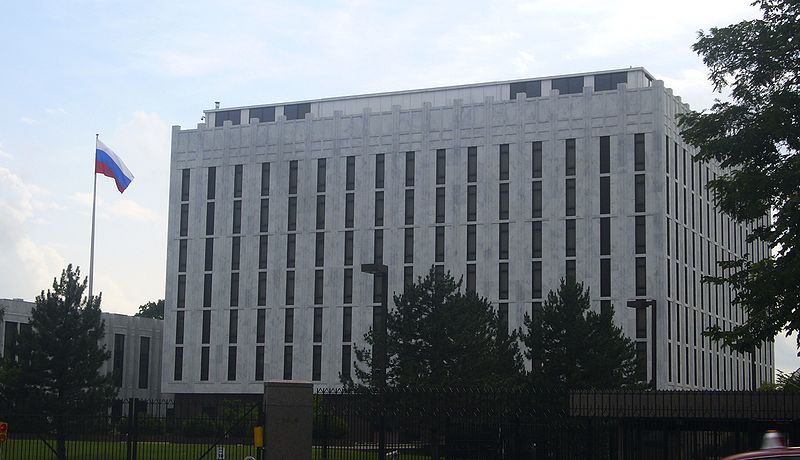
The transition of the Soviet diplomatic mission from the opulent 16th Street mansion to the on Mount Alto represents a decisive shift in Cold War strategy. In 1969 the United States and the Soviet Union signed the Agreement for the Exchange of Sites. This deal is frequently by intelligence historians as one of the most lopsided property exchanges in diplomatic history. The Soviets obtained the Mount Alto Veterans Hospital site at 2650 Wisconsin Avenue NW. This location sits 350 feet above sea level and ranks as the third-highest point in the District of Columbia. The United States received a low-lying swampy plot in Moscow. The elevation difference gave the Soviets a permanent line-of-sight advantage for microwave interception and electronic surveillance targeting the White House, the Pentagon, and the State Department.
Chief Architect Michael Posokhin designed the new compound. Posokhin served as the Chief Architect of Moscow and brought a distinct Soviet Modernist sensibility to the project. The design prioritizes denial and isolation over the Beaux-Arts engagement of the previous era. The complex includes a chancery, a consulate, residential blocks, and a school. These structures sit behind heavy perimeter walls and iron gates. The administrative building, known colloquially as the "White House" due to its marble cladding, features narrow windows on lower levels to prevent visual intrusion. The layout forces all visitors through a controlled tunnel-like entry system that isolates vehicular traffic from the main structures. This architectural hardening reflects a paranoid operational philosophy that assumed constant surveillance by host nation security services.
The paranoia was justified. In 1977 the Federal Bureau of Investigation and the National Security Agency initiated Operation Monopoly. The FBI purchased a residential property at 2619 Wisconsin Avenue NW directly across from the Soviet construction site. Agents dug a tunnel from the basement of this house under the street and into the soil beneath the Soviet compound. The objective was to tap into the embassy's communication lines and plant listening devices within the foundation itself. This engineering feat required silent drilling techniques to avoid detection by the acoustic sensors the Soviets were expected to install.
The Soviet Union anticipated such subterranean threats. The defensive architecture of the Mount Alto complex includes specific countermeasures against physical penetration. While the FBI dug their tunnel, the Soviets installed arrays of seismic sensors and geophones within the foundation and the surrounding soil. These instruments detect the specific vibration frequencies caused by drilling or excavation equipment. The effectiveness of these sensors became a moot point in 1989. FBI agent Robert Hanssen betrayed the operation to the KGB. Hanssen revealed the exact location and purpose of the tunnel. This intelligence allowed the Soviets to feed disinformation through the compromised channels or simply ignore them while securing their internal spaces.
The existence of the tunnel and the reciprocal bugging of the new U. S. embassy in Moscow led to a decade-long standoff. The Mount Alto complex stood largely empty from its completion in 1985 until 1994. It served as a "ghost embassy" where lights burned automatically no diplomats worked. During this interregnum the Soviets and later the Russian Federation stripped the interior down to the concrete to remove American listening devices. They imported verified materials and workers from Russia to rebuild the secure areas. This reconstruction focused on the creation of Sensitive Compartmented Information Facilities (SCIFs). These rooms use copper shielding to create Faraday cages that block all electromagnetic emissions. The "Fishbowl" is the most famous of these secure zones and sits within the center of the chancery to prevent laser microphone attacks on exterior windows.
| Feature | Soviet Site (Washington, D. C.) | U. S. Site (Moscow) |
|---|---|---|
| Location | Mount Alto (2650 Wisconsin Ave NW) | Krasnaya Presnya (Lowland) |
| Elevation | 350 ft (107 m) above sea level | Floodplain level |
| SIGINT Value | Direct line-of-sight to Capitol/Pentagon | Obstructed by urban density |
| Subsurface Threat | FBI Tunnel (Operation Monopoly) | KGB structural bugs in columns |
| Occupancy Date | 1994 (Full operations) | 2000 (New building required) |
The seismic defense grid remains active in 2026. Modern ground sensors use fiber-optic acoustic sensing to detect footsteps or digging attempts with extreme precision. The Russian Federation continues to upgrade these systems to counter autonomous burrowing drones or advanced ground-penetrating radar. The physical separation of the residence from the chancery also serves a defensive purpose. It ensures that intelligence officers can operate in the secure block without the risk of compromising family members in the living quarters. The entire compound functions as a self-contained city. It has its own water filtration and power redundancy systems to survive a utility grid severance.
The resolution of the tunnel incident required high-level political intervention. The Russian Federation occupied the Mount Alto complex fully in September 1994. This move occurred only after the United States agreed to allow the Russians to inspect the concrete for bugs. The discovery of the tunnel by the American public in 2001, following Hanssen's arrest, confirmed the long-held suspicions of local residents who had observed the unusual activity at the "safe house" across the street. The house at 2619 Wisconsin Avenue NW stands today as a monument to the failure of physical penetration against a target that knew the attack was coming.
Current security at the embassy involve a mix of Brutalist physical blocks and invisible electronic shields. The roof of the chancery bristles with antennas and radomes. These devices serve dual purposes. They transmit diplomatic cables via encrypted satellite links and they intercept local cellular and radio traffic. The high ground of Mount Alto remains the primary asset of the site. Even with the advent of cyber warfare the physics of radio wave propagation make this hill a serious node in the Russian intelligence network in North America. The sensors in the basement ensure that the ground beneath their feet remains solely under their control.
Boris Nemtsov Plaza Renaming and Municipal Psychological Tactics
On February 27, 2018, the District of Columbia government executed a precise act of cartographic warfare against the Russian Federation. Coinciding with the third anniversary of the assassination of Russian opposition leader Boris Nemtsov, the D. C. Council officially renamed the block of Wisconsin Avenue NW directly in front of the Russian Embassy "Boris Nemtsov Plaza." This legislative maneuver, authorized under Bill 22-539, was not a commemorative gesture a calculated psychological operation intended to force the Russian diplomatic mission to list the name of Vladimir Putin's murdered rival on their official letterhead, business cards, and visa applications.
The mechanics of this renaming reveal the unique power the District holds over foreign missions, bypassing the State Department's preference for diplomatic neutrality. Councilmember Mary Cheh introduced the legislation, which passed unanimously on January 9, 2018. The act the unit block of Wisconsin Avenue NW, between Davis Street and Edmunds Street, as the new plaza. Under D. C. law, this designation legally altered the embassy's primary address from 2650 Wisconsin Avenue NW to 1 Boris Nemtsov Plaza. The intent was to compel every piece of incoming mail and every outgoing consular document to bear the name of the man gunned down on the Bolshoi Moskvoretsky in 2015.
The Russian Federation's response was immediate bureaucratic resistance. Rather than acknowledging the municipal statute, the embassy continued to use the 2650 Wisconsin Avenue designation on all official correspondence. By 2026, the mission's website and consular forms still steadfastly refused to recognize the Nemtsov address, relying on the pre-2018 coordinates to route mail. This refusal created a dual reality: physically, the street signs bear Nemtsov's name and visitors must cross his plaza to enter the compound; administratively, the Russian government operates in a phantom zone where the renaming never occurred.
This tactic of "address trolling" has a specific lineage in Washington's Cold War history. In 1984, following the internal exile of dissident physicist Andrei Sakharov, the U. S. Congress, rather than the D. C. Council, renamed the block in front of the then-Soviet Embassy on 16th Street NW as "Andrei Sakharov Plaza." The psychological impact then was similar: Soviet diplomats were forced to confront the name of their most famous domestic critic daily. When the Soviet Union collapsed and the new Russian Federation emerged, the stigma faded, only to be resurrected three decades later on Mount Alto with the Nemtsov designation.
Following the full- invasion of Ukraine in February 2022, the municipal siege of the embassy intensified, moving from official legislative acts to guerrilla urbanism. In March 2022, activists affiliated with the Mad Dog PAC planted high-fidelity street signs reading "President Zelensky Way" on the embassy's perimeter. Unlike the Nemtsov renaming, this was initially an unsanctioned installation, yet it remained in place for extended periods due to the permissive attitude of local law enforcement toward anti-Russian protests. The visual around the compound became a gallery of resistance, with sunflowers, the national flower of Ukraine, planted in tree boxes and painted on sidewalks, creating a permanent yellow-and-blue cordon that diplomats had to traverse.
The psychological pressure escalated into a "war of lights" during the spring of 2022, a conflict that continued sporadically through 2025. Activists led by Benjamin Wittes used high-powered theater projectors to beam the Ukrainian flag and images of war crimes directly onto the embassy's white facade at night. The Russian mission retaliated with high-intensity, attempting to wash out the projections. This nightly cat-and-mouse game turned the embassy's exterior into a billboard of the conflict, visible for miles across Northwest Washington. The embassy staff, unable to physically remove protesters standing on public land, were reduced to using photons to scrub their walls of the blue and yellow insignia.
| Year | Target Location | New Designation | Legislative Body | Diplomatic Target |
|---|---|---|---|---|
| 1984 | 1125 16th St NW | Andrei Sakharov Plaza | U. S. Congress | Soviet Union (Human Rights) |
| 2018 | 2650 Wisconsin Ave NW | Boris Nemtsov Plaza | D. C. Council | Russian Federation (Assassination) |
| 2018 | New Hampshire Ave NW | Jamal Khashoggi Way | D. C. Council | Saudi Arabia (Assassination) |
| 2022 | 2650 Wisconsin Ave NW | President Zelensky Way* | Activists (Unofficial) | Russian Federation (Invasion) |
By 2026, the area surrounding the Mount Alto compound had evolved into a permanent protest zone, codified by both statute and practice. While the Russian government successfully ignored the postal of the Nemtsov renaming, they could not escape the physical reality of the location. The embassy stands as a not just against espionage, against the city itself, which has weaponized its zoning codes and street lamps to maintain a constant, low-level siege on the diplomatic mission.
2016 Compound Seizures and Maryland Retreat Closure Fallout
The diplomatic war between Washington and Moscow reached a breaking point on December 29, 2016, when the Obama administration issued Executive Order 13757. In a move devoid of the usual diplomatic subtleties, the White House declared 35 Russian officials persona non grata and ordered the immediate closure of two recreational compounds owned by the Russian government. The most prominent of these was the 45-acre estate at Pioneer Point in Centreville, Maryland, a property that had served as a retreat for Soviet and Russian diplomats since 1972. While officially a vacation spot for embassy staff and their families, American counter-intelligence agencies had long the site as a forward operating base for signals intelligence (SIGINT) collection targeting the Washington metropolitan area.
The eviction notice gave the Russians a mere 72 hours to vacate the premises. Local residents in Centreville witnessed a frantic exodus as caravans of diplomatic vehicles, heavy trucks, and buses stripped the compound of equipment, furniture, and documents. By noon on December 30, the gates were locked, and the U. S. State Department took custody of the property. The seizure marked the time since the Cold War that the United States had physically confiscated diplomatic property owned by a major power, a step that legal scholars and historians noted was a severe escalation in statecraft. The Maryland compound, along with a similar 14-acre estate in Upper Brookville, New York, remains under U. S. federal control as of March 2026, standing as a decaying monument to the collapse of bilateral relations.
Pioneer Point possesses a history that predates its involvement in international espionage. The land was originally part of a 17th-century British land grant, its modern significance began in 1925 when John J. Raskob, the builder of the Empire State Building and a General Motors executive, purchased the estate. Raskob constructed a 19-room Georgian-style brick mansion, known as Hartefeld Hall, which became the centerpiece of the property. In 1972, the Soviet Union purchased the estate for approximately $1. 2 million (adjusted for inflation, roughly $8. 5 million in 2026). For decades, the "dacha" served as a pressure valve for Soviet diplomats confined to the 25-mile travel radius around Washington. They built tennis courts, a soccer field, and swimming facilities, integrating partially with the local community through annual regattas and social events.
Yet, the Federal Bureau of Investigation viewed the amenities as a cover for more nefarious activities. The compound's location on the confluence of the Corsica and Chester rivers provided an unobstructed line of sight for intercepting communications from the nearby naval and military installations in Maryland and Virginia. Intelligence reports declassified in the years following the seizure show that the FBI suspected the Russians of using the attic of the Raskob mansion to house electronic listening devices capable of monitoring sensitive U. S. government frequencies. The isolation of the Eastern Shore allowed Russian operatives to meet with assets away from the intense surveillance grid of downtown D. C., turning the "summer camp" into an operational hub for the SVR and GRU.
The from the 2016 seizures extended well into the decade. Initially, the Kremlin delayed retaliation, anticipating a reversal of the policy by the incoming Trump administration. When that reversal did not materialize, and Congress codified the sanctions into law, the diplomatic row spiraled. In August 2017, the U. S. ordered the closure of the Russian Consulate General in San Francisco and trade annexes in Washington and New York. Russia responded by ordering a reduction of U. S. diplomatic staff in Russia by 755 personnel. This tit-for-tat expulsion pattern left the massive Embassy complex on Mount Alto understaffed and, with the Maryland retreat, once a important morale booster for staff, permanently off-limits.
By 2024, the status of Pioneer Point shifted from a diplomatic bargaining chip to a chance asset for forfeiture. The passage of the Rebuilding Economic Prosperity and Opportunity (REPO) for Ukrainians Act in April 2024 granted the U. S. President the authority to seize Russian sovereign assets to fund Ukrainian reconstruction. While the act primarily targeted financial reserves, the legal language created a pathway for the permanent expropriation of diplomatic real estate. As of 2026, the State Department continues to pay for the basic maintenance of the grounds to prevent total dilapidation, a cost borne by American taxpayers. The mansion stands empty, its windows dark, while the overgrown tennis courts serve as a visual metric of the frozen dialogue between the two nuclear powers.
| Date | Event | Details |
|---|---|---|
| Dec 29, 2016 | Compound Seizure | Obama admin seizes Pioneer Point (MD) and Norwich House (NY); expels 35 diplomats. |
| May 31, 2017 | Failed Negotiation | Trump admin considers returning compounds; plan abandoned after congressional pressure. |
| Aug 31, 2017 | San Francisco Closure | U. S. orders closure of Russian Consulate in SF and annexes in DC/NY. |
| Mar 26, 2018 | Skripal Expulsions | U. S. expels 60 Russian diplomats and closes Seattle consulate following Salisbury poisoning. |
| Apr 15, 2021 | SolarWinds Sanctions | Biden admin expels 10 diplomats; restricts purchase of Russian sovereign debt. |
| Apr 24, 2024 | REPO Act Signed | U. S. law authorizes seizure of Russian sovereign assets for Ukraine aid. |
| Mar 06, 2026 | Current Status | Compounds remain under U. S. custody; Russia denies U. S. access to Moscow dacha. |
The closure of the Maryland compound also severed a unique cultural link. For forty years, the residents of Centreville had an unusual front-row seat to the Cold War, frequently sharing crab feasts and vodka with the perceived enemy. The absence of the Russians has damaged the local economy, which relied on the embassy's steady purchase of supplies and services. yet, the security outweighed the local economic benefits. The FBI's assessment that the compound was a "nest of spies" became the prevailing narrative, justifying the continued lockout. In 2026, the Russian Embassy in Washington operates strictly within its Mount Alto, denied the rural respite that once allowed its intelligence officers to blend in with the Maryland gentry.
Post-2022 Perimeter Fortification and Sunflower Protest Zones
| Date | Event / Escalation | Key Actors | Outcome |
|---|---|---|---|
| Feb 24, 2022 | "MURDER" Graffiti Incident | Local Activists | Sidewalk defaced; Secret Service establishes permanent barricade perimeter. |
| Mar 6, 2022 | "President Zelensky Way" Signage | Claude Taylor / Mad Dog PAC | Unofficial street sign erected; becomes focal point for media coverage. |
| Apr 13, 2022 | Start of "Special Military Operations" | Benjamin Wittes | Laser projections of Ukrainian flag begin; Embassy responds with. |
| Summer 2022 | The Sunflower Wars | Residents vs. Embassy Staff | Sunflowers planted in tree boxes; Embassy staff filmed uprooting and stomping on plants. |
| 2023, 2024 | "Z" Countermeasures | Russian Embassy Security | Embassy uses high-lumen searchlights to project "Z" and "V" symbols to wash out protest lasers. |
| 2025, 2026 | Institutionalized Siege | US Secret Service / Activists | Protest zone becomes permanent fixture; Embassy operates in total social isolation. |
2024 Biometric Surveillance Upgrades and Roof Array Expansion

By late 2024, the Russian Embassy on Mount Alto had ceased to be a diplomatic outpost and had fully evolved into a hardened node of the Kremlin's global electronic warfare and surveillance grid. The most visible manifestation of this shift occurred on the roof of the Chancery at 2650 Wisconsin Avenue NW. Long known as a high-ground listening post due to its elevation of 107 meters above sea level, the third-highest point in the District of Columbia, the compound's skyline underwent a distinct transformation starting in the spring of 2024. Satellite imagery and ground-level observation confirmed the installation of new, smaller-profile radomes and phased-array antenna structures, distinct from the massive parabolic dishes of the Cold War era. These upgrades mirrored similar technical expansions observed at Russian diplomatic missions in Chisinau, Moldova, and across Northern Europe during the same period, signaling a coordinated modernization of the Main Intelligence Directorate's (GRU) signals intelligence (SIGINT) capabilities.
The 2024 roof array expansion was not simply a maintenance pattern; it represented a shift toward intercepting advanced digital. Intelligence analysts noted that the new equipment appeared designed to target "remnant" signals, digital exhaust from encrypted communications, and to geolocate mobile devices within the government-heavy corridors of Glover Park and Georgetown. Unlike the passive listening of the 1980s, these new MIMO (Multiple Input Multiple Output) arrays allowed for the simultaneous tracking of thousands of unique identifiers, feeding data directly into the "Aquarium" (GRU headquarters) in Moscow. This aggressive posture coincided with FBI Director Christopher Wray's public warnings in late 2023 and 2024 regarding the "way too big" footprint of Russian intelligence officers operating on U. S. soil, a number that had remained stubborn even with repeated expulsions.
Simultaneously, the Embassy's Consular Division implemented a draconian new biometric surveillance regime. On December 1, 2024, the Russian Federation initiated a "biometric experiment" for foreign citizens, a decree signed by Prime Minister Mikhail Mishustin. While publicly framed as a border security measure for airports like Sheremetyevo, the Washington embassy served as a primary collection point for the "Digital Profile of a Foreign Citizen" database. Applicants for visas, including journalists, business travelers, and dual citizens, were required to interface with new biometric kiosks installed within the consular waiting rooms. These units captured not only high-resolution facial topography also ten-print fingerprint data, which was immediately cross-referenced with the FSB's unified biometric system. This turned the visa processing window into a forward-deployed intelligence collection station, linking the physical identity of U. S. persons to their digital footprints before they ever boarded a flight to Moscow.
The irony of this high-tech surveillance was exposed in March 2026, when an open-source intelligence (OSINT) investigation revealed a lapse in the Embassy's own operational security. While the roof bristled with classified intercept technology, the defense, military, and air attaché offices were found to be conducting official business using unsecured, free email services. The investigation identified accounts such as defattru@msn. com and rusmilatt@hotmail. com being used for sensitive coordination. One particularly egregious breach linked sixteen different embassy email addresses to a single Napster account registered to a civilian in the D. C. area, exposing the personal IP addresses and device identifiers of high-ranking diplomatic staff. This juxtaposition, state-of-the-art SIGINT arrays on the roof and Hotmail accounts in the basement, painted a picture of a mission that was technically formidable yet culturally prone to sloppy tradecraft.
The physical perimeter of the Mount Alto compound also saw reinforcement in response to what Ambassador Anatoly Antonov described as a "besieged " environment. Following the 2024 election interference warnings issued by the Office of the Director of National Intelligence (ODNI), the embassy anticipated renewed protests and chance expulsion orders. In response, the mission hardened its access control points. The "experiment" with biometrics was not limited to visa applicants; new facial recognition cameras were mounted at the Wisconsin Avenue gates, scanning every vehicle and pedestrian that lingered near the entrance. These feeds were reportedly integrated with the "Video Stream Processing Center," a Moscow-based centralized surveillance platform funded by a 1. 4 billion ruble allocation in the 2024 Russian federal budget. This integration meant that a protestor standing on a sidewalk in Washington, D. C., could be identified and indexed by an AI model running on servers in the Russian Federation in near real-time.
The technological escalation of 2024, 2025 fundamentally altered the unspoken rules of the "embassy wars." For decades, the game had been played with bugs in the walls and tunnels under the street. The new era was defined by the silent, constant vacuuming of biometric and digital identity data. The roof arrays sucked in the "pattern of life" signals from the surrounding city, while the consular kiosks harvested the biological signatures of those seeking entry to Russia. By 2026, the Embassy of Russia in Washington had become less of a diplomatic and more of a semi-autonomous intelligence platform, operating behind a veil of diplomatic immunity while aggressively mapping the human and digital terrain of the American capital.
Sovereign Immunity Disputes and Unpaid District Utility Debts
The Mount Alto compound functions not as a diplomatic outpost as a financial, shielded by the Vienna Convention from the civil liabilities that bind ordinary entities in the District of Columbia. For decades, the Embassy of Russia and its Soviet predecessor used sovereign immunity to deflect millions of dollars in municipal fines, court-ordered sanctions, and utility obligations. This legal armor creates a permanent friction with the State Department's Office of Foreign Missions (OFM) and local creditors, turning routine billing disputes into tests of international law. The immunity defense remains absolute in most property matters, yet the political cost of these unpaid debts frequently triggers retaliatory measures from the host government.
Traffic violations constitute the most visible of this fiscal defiance. Between 1993 and 2002, Russian diplomatic vehicles in Washington and New York accumulated unpaid parking fines on an industrial. In 2011, data released by the State Department identified the Russian Federation as a primary scofflaw, with 892 outstanding tickets in the District alone, totaling over $27, 000 in fines. Unlike the United Nations mission in New York, where debts exceeded $100 million, the Washington fleet faced direct federal intervention. The OFM implemented a strict policy in 2002: missions with three or more unpaid tickets for over a year face the suspension of diplomatic license plate registrations. This method forced a partial compliance, yet the embassy frequently pattern vehicles or contests tickets to delay payment, treating the fines as illegitimate taxes on sovereign functions.
The limits of this immunity faced a grim test in 1997 following the drunk-driving death of 16-year-old Joviane Waltrick, caused by Georgian diplomat Gueorgui Makharadze. While Makharadze was not Russian, the incident occurred within the tight-knit post-Soviet diplomatic community of DC and set a precedent that terrified the Russian mission. The State Department successfully pressured Georgia to waive immunity, leading to Makharadze's imprisonment. Russian legal advisors viewed this waiver as a dangerous of the absolute protection they historically claimed. Since that ruling, the Russian Embassy has aggressively settled injury claims out of court to avoid any scenario where a waiver might be requested, buying silence to preserve the legal shield.
A far more expensive legal battle unfolded regarding the Schneerson Collection, a library of sacred Jewish texts held by the Russian government. In Agudas Chasidei Chabad v. Russian Federation, a US District Court judge imposed civil contempt sanctions of $50, 000 per day on the Russian government for refusing to return the books. By 2015, these unpaid fines exceeded $43 million. Russia withdrew from the proceedings, declaring the court had no jurisdiction over its sovereign property. The debt ballooned to over $175 million by the early 2020s. Plaintiffs attempted to seize assets from Tenex-USA, a Maryland-based subsidiary of the Russian state nuclear company Rosatom, to satisfy the judgment. The legal war concluded only in January 2026, when the US Supreme Court declined to review a DC Circuit decision that vacated the fines. The appellate court ruled that the Foreign Sovereign Immunities Act (FSIA) did not grant jurisdiction over property located in Russia, granting the Embassy a massive victory and erasing the nine-figure debt from the books.
The financial operational capacity of the embassy collapsed following the February 2022 invasion of Ukraine. US sanctions did not technically bar the embassy from paying utility bills, yet American banks refused to process the transactions. In April 2022, Ambassador Anatoly Antonov stated that Bank of America had closed the accounts of the Russian consulates in Houston and New York and blocked the embassy's transfers. The mission faced a "blockade," unable to pay for electricity, water, or insurance through standard electronic channels. To maintain operations on Mount Alto, the embassy resorted to cash reserves and complex routing through friendly third-party banks. While the District of Columbia Water and Sewer Authority (DC Water) does not publicly disclose specific account delinquencies, the embassy avoided utility shutoffs, likely by physically delivering payments or using diplomatic couriers to move cash, a regression to 19th-century fiscal logistics.
Retaliation for these disputes escalated on June 22, 2024, when the US government stripped Russian diplomats of their tax exemption cards. For decades, embassy staff held cards allowing them to bypass sales taxes and specific municipal levies, a standard diplomatic courtesy. The revocation forced Russian personnel to pay local taxes on all purchases, from gasoline to groceries, increasing the mission's operating costs by 6% to 10% overnight. Ambassador Antonov denounced the move as a "petty, nasty step" designed to drain the mission's resources. This administrative strike bypassed the courts entirely, imposing a financial penalty that sovereign immunity could not block.
By March 2026, the embassy faces a new wave of legal challenges under the FSIA. In Yukos Capital v. Russian Federation, Judge Carl J. Nichols ruled that serving legal papers to the embassy in Washington constituted valid service of process, rejecting Russia's argument that documents must go through the Foreign Ministry in Moscow. This ruling opens the gates for creditors and arbitration winners to utilize the Mount Alto compound as a legal reception desk for billion-dollar claims. Simultaneously, the DC Circuit's February 2026 hearing in Stabil LLC v. Russian Federation regarding assets in Crimea suggests that while the embassy avoided the Chabad fines, the courtroom siege on its sovereign assets remains active.
| Year | Incident / Dispute | Financial Implication | Outcome |
|---|---|---|---|
| 1997 | Makharadze Precedent | Liability for criminal negligence | Immunity waived (Georgia); Russia tightens settlement. |
| 2002 | OFM Parking Crackdown | ~$27, 000 (est. arrears) | registrations suspended for 3+ unpaid tickets. |
| 2013, 2026 | Chabad Library Fines | $175, 000, 000 (vacated) | DC Circuit rules FSIA bars jurisdiction; fines erased Jan 2026. |
| 2017 | Compound Seizures | Property loss (Centreville, MD) | US seized dachas; Russia demands compensation/return. |
| 2022 | Banking Blockade | Frozen operating funds | Bank of America closes accounts; shift to cash operations. |
| 2024 | Tax Card Revocation | +6-10% operational cost | US strips tax exemption status from diplomats. |
| 2025 | Yukos Service Ruling | Procedural vulnerability | Court rules Embassy must accept service for lawsuits. |
2026 Diplomatic Staff Reductions and Visa War Retaliations
| Date | Event | Operational Impact |
|---|---|---|
| Dec 2016 | Expulsion of 35 diplomats; Compound seizures | Loss of recreational retreats in MD and NY. |
| Aug 2017 | Closure of San Francisco Consulate | West Coast consular services terminated. |
| Mar 2018 | Expulsion of 60 diplomats (Skripal case) | Seattle Consulate closed; massive staff reduction. |
| May 2021 | U. S. Embassy Moscow halts non-diplomatic visas | Russians forced to apply in third countries. |
| Jun 2024 | Closure of Russian Visa Centers (DC/NY) | End of outsourced visa processing; tax privileges revoked. |
| Feb 2025 | Executive Order "One Voice" | Mandated 10% global staff cut; tighter travel zones. |
| Jan 2026 | Indefinite Immigrant Visa Suspension | Green Card processing halted for Russian nationals. |
The contrast with the historical trajectory of the Russian presence is clear. In the 1700s and early 1800s, Russian envoys like Andrei Daschkov operated with considerable social and political latitude, even with the absence of a formal embassy building. By the Cold War peak in the 1980s, the Soviet Embassy was a self-contained city with over 1, 000 personnel, including drivers, cooks, and teachers. The 2026 mission, by comparison, relies on a skeleton crew where senior diplomats frequently double as administrative support. The "three-year rule," strictly enforced by Moscow to rotate staff before they can be compromised by American intelligence, further churns the limited pool of available personnel, leaving the embassy in a permanent state of transition. Intelligence gathering, the primary function of the Mount Alto compound since its construction, faces new friction. While the rooftop antennas and underground fiber-optic taps remain active, the human intelligence (HUMINT) network is severely constrained. The removal of tax exemptions in 2024 allowed U. S. authorities to track the financial footprints of embassy staff with greater precision, mapping their movements and purchases in real-time. The travel radius for Russian diplomats, once a 25-mile zone requiring notification, is a rigid confinement enforced by the threat of immediate expulsion. As of March 2026, the Embassy of the Russian Federation stands as a monument to diplomatic failure. The Beaux-Arts mansion on 16th Street, once the vibrant center of Imperial social life, sits quiet, while the Mount Alto compound is a silent watchtower. The "Visa War" has ended the era of people-to-people exchange, returning the relationship to a condition more restrictive than the Iron Curtain. For the few remaining staff under Ambassador Darchiev, the mission is no longer about engagement survival, holding the physical ground of the sovereign territory while the diplomatic burn around them.